

Online exhibition
A number of design changes were made including reducing the size of the scheme to 21 turbines and reducing the tip height of 11 turbines. In addition, turbines were moved away from areas of deep peat and to avoid encroaching on watercourse buffers.
We also changed the name of the project to Bloch Wind Farm to better reflect its location close to Bloch Hill.
On Tuesday 4th October 2022 we launched an online exhibition to present the updated plans for the wind farm. We also ran a number of drop-in sessions in the area, where information on the updated plans were available to view and members of the project team were on hand, to answer any questions and provide further information.
Design layout and infrastructure
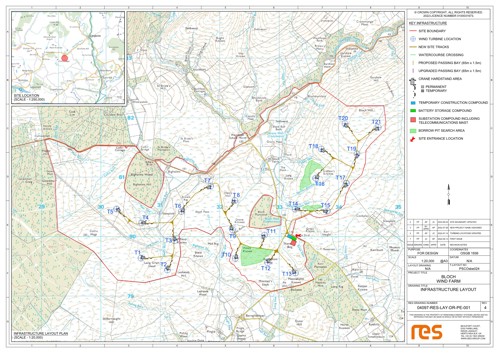
The plan to the left shows the updated layout for the Bloch Wind Farm, which consists of 21 wind turbines, up to 230m tall.
The wind farm is likely to have an installed capacity of up to 126 megawatts (MW) and will be capable of providing renewable electricity for around 100,000 homes1
A number of changes have been made to the site layout, since our public exhibition in June 22. These include reducing the scheme from 22 to 21 wind turbines and reducing the tip height of 6 wind turbines to 200m and 5 wind turbines to 180m. Wind turbines have also been moved to avoid areas of deep peat and to avoid encroaching on watercourse buffers. Further information on the design changes can be found here.
In addition to the wind turbines and foundations, the site infrastructure is expected to include:
- hardstand areas for erection cranes at each wind turbine location
- a network of tracks including passing places and site entrances from the public road
- borrow pits (dependent on availability of stone on site)
- a substation compound containing a control building and communications mast
- a compound for energy storage
- temporary construction compounds.
What Would the Wind Farm Look Like?
We have produced indicative visualisations and wirelines to help give an impression of what the updated design of the wind farm could look like from different viewpoints in the area. Click on the links to view.
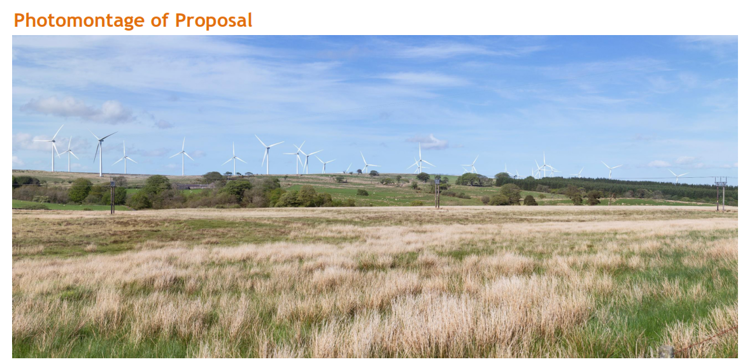
Example from VP1
Zone of Theoretical Visibility (ZTV)
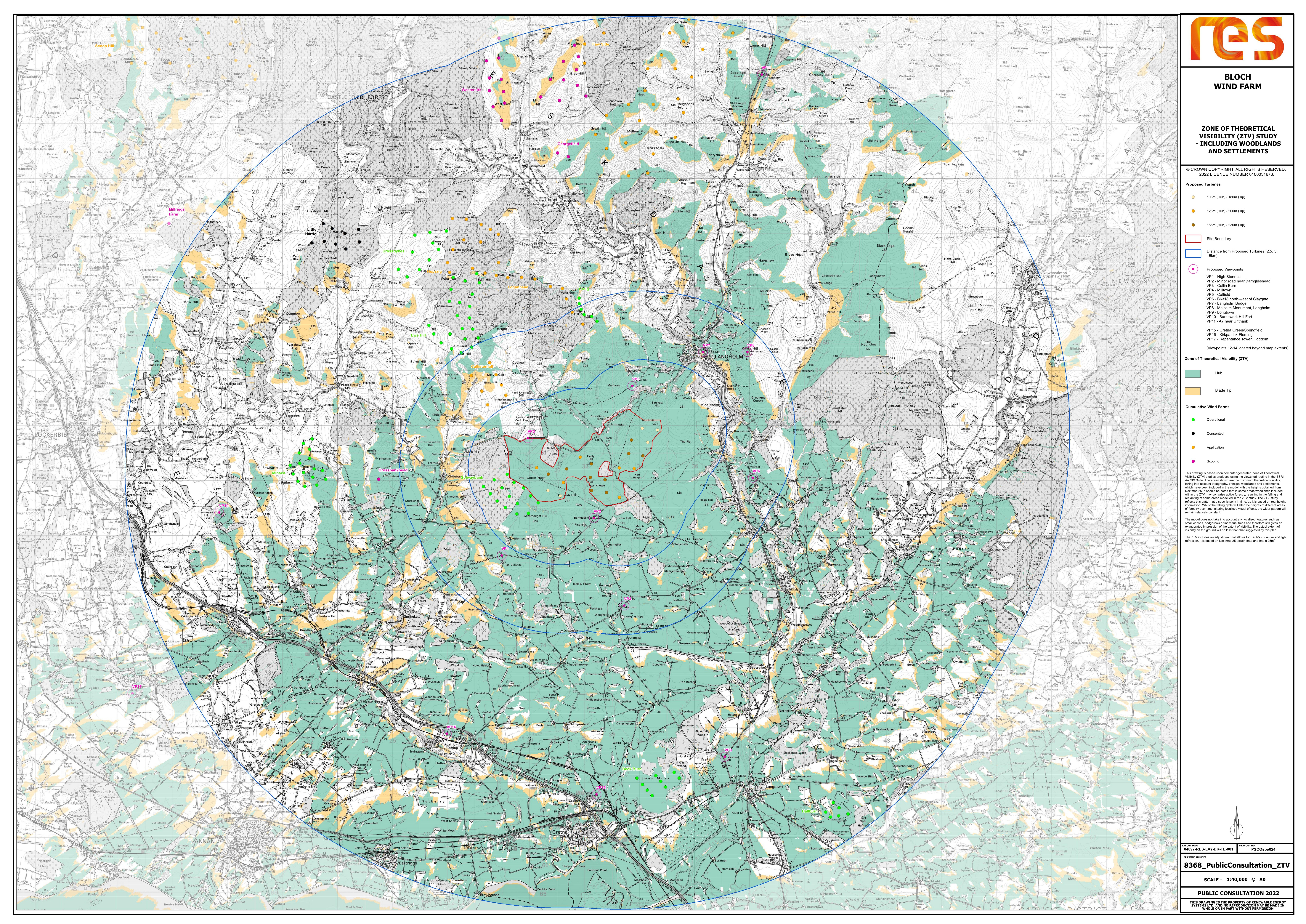
We have also produced an indicative Zone of Theoretical Visibility (ZTV) Map showing where the turbines could be visible from.
Please note that this is based on bare land form without taking into account any screening effects of trees and buildings.
In response to feedback from the first public exhibition we have reduced the area presented to 15km to improve readability and included adjacent wind farms in operation, in planning or in scoping for context.
Supply chain opportunities
The proposed Bloch Wind Farm is predicted to deliver approximately £5.8 million of local economic benefit in the form of jobs, employment and the use of local services.
Some of the skills, services and materials which are likely to be required include:
- civil engineering
- groundworks
- electrical works
- steel fixing
- plant operators
- labourers
- cleaners
- plant hire
- crane hire
- concrete & aggregates
- local accommodation
If you’re a local business who may be able to offer skills or services during the construction or operation of Bloch Wind Farm and would like to know more about the project, please contact us.
1 The homes figure has been calculated by taking the predicted annual electricity generation of the site, based on a preliminary design (based on RES assessments Bloch has a predicted capacity factor of 33%) and dividing this by the annual average electricity figures from the Department of Business, Energy and Industrial Strategy (BEIS) showing that the annual UK average domestic household consumption is 3,748 kWh (Dec 2021).